


- This event has passed.
Panel Discussion on Tech Abuse Threats and Accountability: How Can We Work Together?
May 24, 2025 @ 2:30 pm – 5:00 pm
Kuala Lumpur, 24 May 2025 – The panel discussion ‘Tech Abuse Threats and Accountability: How Can We Work Together?’ brought together over 65 participants of digital rights advocates, academics, civil society leaders, and platform companies representatives from the region. This event was part of the ASEAN Peoples @ ASEAN2025 Forum. INITIATE.MY co-organised the session with EngageMedia and the Malaysian Centre for Constitutionalism and Human Rights (MCCHR) to explore the rising threats and solutions to technology abuse in Southeast Asia.
Aizat Shamsuddin, Founder of INITIATE.MY, highlighted the growing threats of online scamming and digital extremism in Southeast Asia. He noted that countries in the region serve as both hosts and victims of increasingly coordinated scams, including those using AI-generated fake content to deceive the public and bypass platform enforcement.
He referred to INITIATE.MY’s May 2024 report on far-right extremism trends during Malaysia’s 15th General Election, which exposed how far-right actors used social media to incite racial hatred and revive May 13 narratives through coded language, songs, and symbols. Aizat attributed these harms not only to weak platform moderation but also to systemic issues like gaps in the education system.
He stressed the need for better cooperation with agencies like the Royal Malaysia Police, real-time information sharing, and more effective AI content moderation—while warning against overreaching security laws that risk silencing legitimate expression. He pointed to Singapore’s FICA law as a case for reflection. Rather than defaulting to criminalisation, Aizat urged a focus on building digital resilience and literacy, especially among youth, ahead of future elections.
Damar Juniarto, Founder of the Centre for AI & Tech Innovation for Democracy (PIKAT) Indonesia, warned that the internet has strayed from its democratic roots and become dominated by tech platforms that exploit user data and undermine accountability—what he described as “technofeudalism.” In Indonesia, platforms like YouTube and Facebook have displaced traditional media, causing journalist job losses and weakening democratic safeguards.
He highlighted four key forms of digital repression in Southeast Asia: information warfare, content takedowns, digital surveillance, and online censorship. Damar stressed that authoritarian regimes and tech companies are both complicit in this growing tech abuse. To counter this, he proposed a post-Western digital rights manifesto, including cyber diplomacy, technology transfer in local languages, a Publishers’ Right Committee to support independent media, and decentralised platforms to protect civic space. He called for multi-stakeholder accountability and region-specific strategies to defend democracy in the digital age.
Dr. Jun-E Tan, Senior Research Associate at Khazanah Research Institute, highlighted the urgent need for structured monitoring and documentation of AI-related harms in Malaysia and Southeast Asia. She called for greater public awareness and research on AI safety, distinguishing it from unrealised risks or “hazards.”
Dr. Tan emphasised the value of AI incident repositories—like AIAAIC, OECD AIM, MITRE ATLAS, and AVID—that promote transparency and informed policymaking, especially in high-risk sectors. However, she noted significant challenges: vague definitions, long-term harm detection, causality issues, limited awareness, and Southeast Asia’s underrepresentation in global databases.
Despite these difficulties, she argued that documenting AI harms must be prioritised. Establishing robust incident repositories is essential for responsible and accountable AI governance in the region.
Daniel Lim, Head of Public Policy for Malaysia and Brunei at Meta, stressed the need for cross-sector collaboration to ensure a safer online environment. He urged tech platforms, civil society, and regulators to engage in constructive dialogue rather than fear new technologies.
Lim highlighted Meta’s USD 13 billion investment in online safety and its efforts to balance activist rights with content enforcement. He noted that Meta removes over 90% of harmful content and undergoes public audits to ensure transparency. He cautioned against disrupting effective systems and advocated for consultative approaches to regulation.
He cited Meta’s open-source AI model LLaMA and AI content labelling initiatives as examples of responsible innovation. Lim called for legislation that is enforceable, practical, and thoughtful. He reaffirmed Meta’s commitment to free speech while acknowledging the ongoing challenge of effective moderation.
Mediha Mahmood, CEO of the Communications and Multimedia Content Forum of Malaysia (CMCF), emphasised the importance of a collaborative, consultative approach to responsible content governance. She explained that under the Communications and Multimedia Act 1998, the Malaysian Communications and Multimedia Commission (MCMC) enforces regulations while CMCF develops and maintains content standards as an industry-led body.
She noted a shift in public concerns from traditional media to complex online issues like child grooming and explicit content involving minors, which has eroded trust among stakeholders. Mediha called for stronger digital literacy as a core skill, not an add-on, and stressed the urgency of integrating ethical safeguards into laws, standards, and AI systems.
She advocated for consensus-driven governance that protects vulnerable groups—especially women and children—while respecting civil society’s role. While supporting self-regulation, she stressed that it must be backed by shared principles and balanced regulation to uphold freedom of expression.The panel concluded with a strong call for multi-stakeholder collaboration to address Southeast Asia’s most urgent digital threats and rights challenges. Panellists and participants agreed that the session aligned closely with ASEAN’s regional goals, including the ASEAN Digital Masterplan 2025 and the ASEAN Human Rights Declaration, both of which emphasise safe, inclusive, and rights-respecting digital ecosystems.
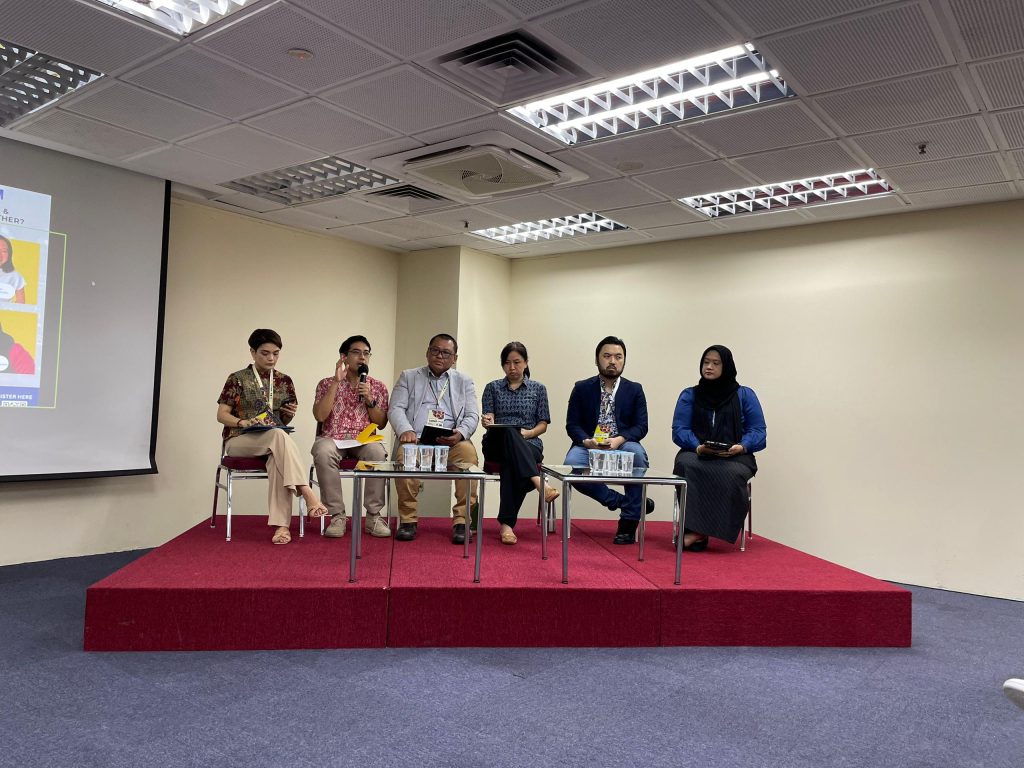
Panelists of the panel discussion were regional voices from civil society, academia, tech industry, and media policy with a common interest in safeguarding safer and rights-based digital futures for Southeast Asia.