


- This event has passed.
Peace Lab for Malaysian Leaders and Thinkers Workshop
October 25, 2025 @ 8:00 am – November 9, 2025 @ 5:00 pm
Online, 25 October, 1-2 November 2025; Kuala Lumpur, 7-9 November 2025 – A total of thirty participants from civil society, legal practice, media, academia, youth organisations and universities enrolled into the Peace Lab for Malaysian Leaders and Thinkers , a programme designed to strengthen their capacity in peacebuilding, digital resilience and community leadership. The initiative consisted of three online workshops and a three day in person workshop, covering five core themes: religious freedom and tolerance, radicalisation, peaceful conflict resolution, advocacy tools, and advocacy skills.
In the first online workshop session, participants explored how misinformation and harmful narratives affect public understanding of religious freedom and tolerance. They examined how misleading content distorts issues related to identity and belief, often turning minor disagreements into perceived threats. Participants also learned how false claims about religious communities move rapidly through memes, short videos, and private chats. They discussed how these narratives weaken trust in democratic protections, strain intergroup relations, and undermine efforts to promote respect and coexistence in the analysis of case studies.
In the second online workshop session, the programme then focused on the radicalisation process, emphasising how hate speech, polarising content, and algorithm driven feeds shape individual behaviour. Participants studied how generative artificial intelligence and deepfake materials enable harmful actors to manipulate emotions and reinforce ideological echo chambers. They looked at case studies where false or exaggerated stories pushed individuals toward closed-minded attitudesand encouraged hostility. In these discussions, participants recognised the importance of building digital literacy and community resilience to counter messages that normalise division or violence.
In the third online workshop session, participants examined how distorted narratives escalate tensions within communities and challenge peaceful conflict resolution. They analysed situations where misinformation amplified fear, directed blame and made constructive dialogue more difficult. The participants discussed how algorithms favour sensational content that deepens misunderstanding and accelerates conflict. They also explored how conflict sensitive communication, mediation practices and community based responses can reduce harm. Participants recognised that addressing misinformation requires not only fact correction, but also efforts to build empathy, trust, and practical mechanisms for resolving disputes.
During the in-person workshop, participants took part in panel discussions and dialogue sessions with practitioners serving in peacebuilding, media, community development, and stakeholder engagement. Participants focused on building practical advocacy skills, beginning with a session on effective community and stakeholder engagements. They explored strategies for organising inclusive community initiatives, strengthening networks, and fostering collaboration across different groups. A session on strategic communications then introduced approaches for creating impactful digital content, including podcasts, newsletters, and documentary style storytelling, while emphasising ethical and responsible communication. Participants also learned about effective documentation and reporting practices, which support transparency, accountability, and long-term project learning. These discussions encouraged participants to think critically about how they plan, communicate, and sustain their future Peace Lab initiatives.
On the second day of the in-person workshop, participants turned their attention to project design and practical implementation. They examined tools for constructing advocacy projects, including goal setting, stakeholder mapping, risk management, and monitoring and evaluation. Facilitators guided them through the development of their Peace Lab project concepts, and participants drafted and presented their ideas for feedback and refinement. This provided participants with a deeper understanding of how different actors approach peace and security issues, and how civil society can contribute constructively. Across both days, participants strengthened their skills in responsible communication, project planning, and collaborative engagement. They gained practical tools to design initiatives that promote inclusion, address community needs, and support peaceful interaction. The programme concluded with reflections and closing remarks, allowing participants to consolidate their learning and prepare for continued involvement in peacebuilding efforts.
As the Peace Lab workshop came to a close, participants left with a strengthened foundation in peacebuilding, advocacy, and community leadership. The combination of digital literacy, conflict sensitive communication, and practical project design equipped them to develop initiatives that respond to real community needs while fostering trust, inclusion, and resilience. Participants gained access toresource support to shape their ideas into meaningful actions that contribute to a more cohesive, informed, and peaceful Malaysian society.
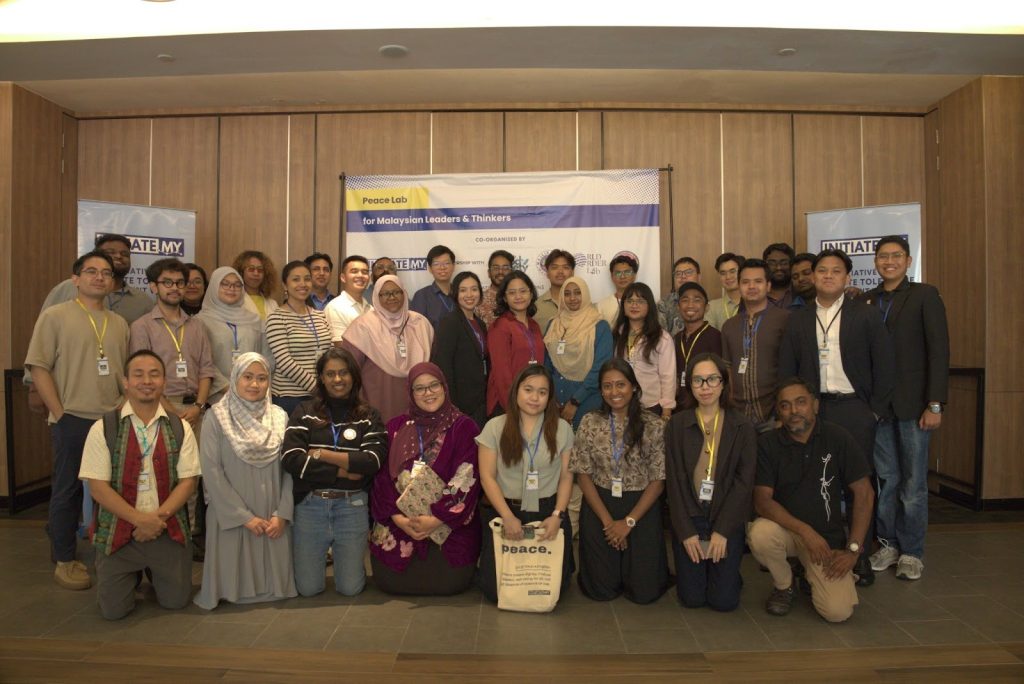
Peace Lab participants celebrate the completion of an intensive learning journey, ready to apply their new skills to strengthen inclusion and resilience in Malaysian communities.