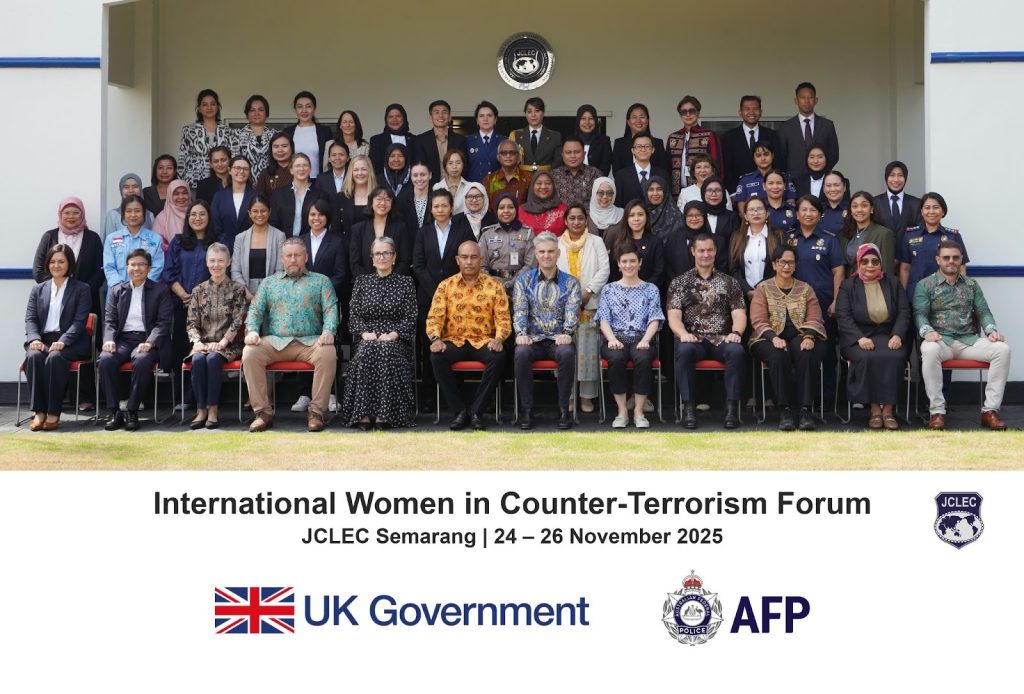

Jakarta, 24–26 November 2025 – Irdina Sofrina, INITIATE.MY’s Programme Associate participated in the 2nd International Women in Counter-Terrorism (CT) Forum held at the Jakarta Centre for Law Enforcement Cooperation (JCLEC). The forum brought together law enforcement officials, security practitioners, academics, and civil society representatives from across Asia, Europe, Australia and beyond.
The three-day forum focused on advancing gender-sensitive approaches to counter-terrorism, with particular attention to radicalisation pathways, rehabilitation and reintegration frameworks, repatriation policies, and the evolving role of women in security and policy spaces.
A key theme that emerged was the need for gender-responsive risk assessment tools. Participants highlighted that many existing frameworks are designed around male pathways into extremism and often overlook women’s lived realities, including domestic abuse, coercion, trauma, caregiving responsibilities, and social dependency.
The concept of “fate-based vulnerability” was discussed to illustrate how structural and personal circumstances can shape radicalisation trajectories. Delegates emphasised that risk assessments should be regularly reviewed through inter-agency coordination rather than conducted only at points of detention or release.
Panels further examined women’s diverse and complex roles within extremist movements, challenging the tendency to frame women solely as passive victims. Case discussions demonstrated how agency exists on a spectrum, shaped by coercion, displacement, forced marriage, economic hardship, and loss. This complexity underscores the importance of rehabilitation programmes that are tailored, context-sensitive and grounded in dignity rather than stereotypes.
Another critical discussion addressed how rehabilitation initiatives sometimes reinforce gender stereotypes, such as limiting women to traditionally “acceptable” vocational pathways, while neglecting their skills and aspirations. Participants also reflected on how stigma—particularly when religious identity is conflated with security risk—can undermine reintegration efforts and entrench marginalisation.
Sessions on youth radicalisation highlighted the shift from physical recruitment spaces to online ecosystems, including gaming platforms, meme cultures, and social media networks. Emerging forms of nihilist violent extremism were discussed, where grievances and alienation may outweigh ideological doctrine. Delegates stressed the importance of whole-of-society approaches that prioritise digital literacy, trust-building and early engagement over heavy-handed restrictions that may push youth further underground.
Delegates identified misogyny as a significant gateway to violent extremism across ideological spectrums, amplified by online algorithms that reward grievance-driven narratives. Participants examined how gender-based resentment can be mobilised into broader extremist movements, reinforcing the need to address gendered hate as an integral component of counter-extremism strategies.
The forum concluded with strong calls for restorative justice approaches that centre dignity, healing, and social belonging. Delegates recognised civil society actors as critical partners in reintegration, with families, workplaces, and communities reframed as essential “safe spaces.” Success indicators were encouraged to extend beyond recidivism rates to include measures of social cohesion and community resilience.
The 2nd International Women in CT Forum reinforced the importance of human-centred, gender-responsive, and community-led approaches to counter-terrorism. For INITIATE.MY, these insights strengthen ongoing commitments to holistic reintegration, psychosocial support and collaborative, rights-based frameworks in addressing violent extremism.