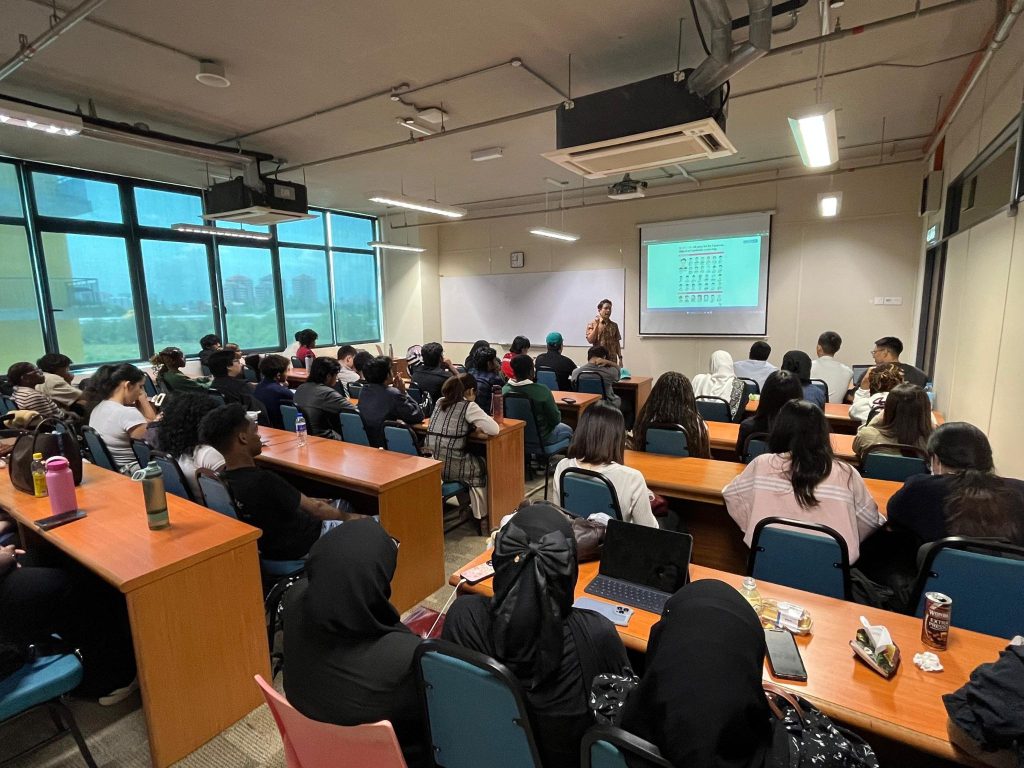

Kuala Lumpur, 9 April 2026 – INITIATE.MY’s Executive Director, Aizat Shamsuddin, delivered a lecture to international relations students at the Asia Pacific University of Technology & Innovation (APU). The lecture examined the rise of transnational cyberscams in Southeast Asia and Malaysia, covering key legal frameworks, emerging trends, and the scale of harm caused by increasingly sophisticated scam operations.
The lecture introduced key international and domestic legal frameworks, including:
- The United Nations Convention against Transnational Organized Crime (UNTOC), the main international framework for addressing transnational organised crime;
- The United Nations Convention against Cybercrime, adopted by the UN General Assembly in December 2024 as the first global treaty framework on cybercrime and electronic evidence;
- Malaysia’s domestic laws, including the Penal Code, the Anti-Money Laundering, Anti-Terrorism Financing and Proceeds of Unlawful Activities Act 2001, the Anti-Trafficking in Persons and Anti-Smuggling of Migrants Act 2007, and the Cyber Security Act 2024;
- Ongoing developments in artificial intelligence governance.
The lecture highlighted cyberscams as a regional crisis, particularly in the Mekong subregion. These operations have evolved into lucrative poly-crime ecosystems involving artificial intelligence deepfakes, fintech exploitation, transnational organised networks, corruption, trafficking, and forced labour. Malaysia has also suffered significant financial losses, with scam trends tracked by the Royal Malaysia Police and the National Scam Response Centre.
The human toll is equally alarming. As of January 2026, more than 1,100 Malaysians were conservatively identified as victims of forced labour in scam compounds, mainly in Myanmar, Cambodia, and Laos. More than 750 have been repatriated, while over 236 remain missing. Victims are predominantly ethnic Chinese and mainly from Johor, Selangor, and Sarawak.
Within Malaysia, authorities have raided more than 270 scam centres across multiple states since 2021, with the highest concentrations in Kuala Lumpur and Johor.
The lecture stressed that disrupting these poly-criminal networks requires coordinated and multi-layered responses, including:
- Updating and enforcing relevant laws;
- Institutionalising and properly resourcing anti-scam efforts;
- Strengthening cooperation between law enforcement, civil society, regulators, financial institutions, and regional partners;
- Addressing enforcement capacity gaps, emerging cross-border crimes, and scam zones operating beyond Malaysia’s jurisdiction.
The lecture reinforced that effective responses to cyberscams require sustained collaboration across borders and sectors.