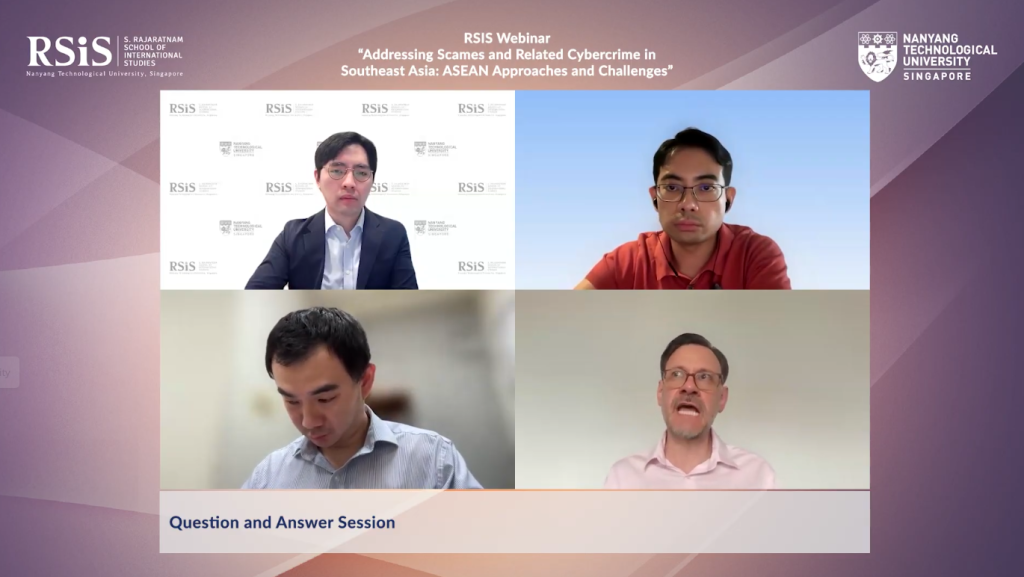

26 March 2026 (Virtual) — The RSIS Webinar “Addressing Scams and Related Cybercrime in Southeast Asia: ASEAN Approaches and Challenges” featured presentations by Aizat Shamsuddin, founder and executive director of INITIATE.MY; Dr Yang, who discussed China’s perspective and the geopolitics of scam operations; and Mr Jason of the Global Initiative Against Transnational Organized Crime (GI-TOC). The recorded version of webinar can be found here: RSIS Webinar on “Addressing Scams and Related Cybercrime in Southeast Asia” on 26 March 2026
During the webinar, Aizat presented an overview of the regional landscape and a deep dive into cyber scams in Malaysia. He highlighted the public’s increasing awareness of cybercrime, noting that coverage had initially come mainly from international organisations but has since expanded to local media, with some of these crimes even adapted into films as part of a wider campaign to raise public awareness. He stressed that cyber scams are deeply interrelated with other forms of cross-border organised crime.
Key points from Aizat’s presentation included:
- Scam cases in Malaysia rose 400% in four years, led by investment fraud targeting high-net-worth individuals and retired professionals.
- Many scam zones have been operating in the Mekong subregions with them targeting foreign nationals.
- Aizat shows the statistics of the total identified Malaysian in forced labour camp as 994. True figures are likely far higher, with NGO estimates almost double official numbers.
- Scam call centres now operate across Malaysia with over 130 in Kuala Lumpur, 60+ in Johor, 45+ in Selangor, plus Sarawak, Sabah, and Penang which shows that it is no longer concentrated in the capital.
- Governance gaps allow transnational operations to exploit work visas and the financial system, for instance by registering as fintech companies.
- Corruption among local law enforcement has been prosecuted in high-profile cases, with parallels in the Philippines.
- Recent operations include Operation Dragon, the arrest of 16 Chinese nationals to China that is believed to be the Kingpin of a global scam network which is an example of foreign nationals using Malaysia as their base for scamming. It is also the first repatriation case involving Chinese nationals involved in a scamming case to China.
- Last year’s Malaysia-led ASEAN Summit sharpened regional focus on transnational cybercrime, but translating this into concrete law enforcement action has lagged.
- Regulations must be balanced across countries to prevent any one becoming a safe harbour.
- Anti-scam efforts should be institutionalised through a permanent body with an annual budget, alongside upcoming regulations engaging tech platforms.
Dr Yang then presented China’s perspective and the geopolitical dimensions of the issue. He noted that estimated losses to Chinese victims run up to a trillion yuan annually. Overseas scam operations targeting China are concentrated in a few key regions, notably Myanmar and Cambodia, which has made the issue a significant driver of Beijing’s engagement with the region.
Mr Jason of GI-TOC discussed regional trends and the evolving international response:
- Myanmar, Cambodia, and Laos remain the main epicentres, with similar trends across all three: clearance operations are often perpetrator-led rather than driven by law enforcement; operations are shifting into new geographies, particularly Sri Lanka; and new financial platforms are emerging to move scam proceeds and cryptocurrency.
- In Myanmar, non-state actors show considerable political will, but neighbouring countries remain hesitant to cooperate — a possible missed opportunity.
- The international response is growing: action by the US and UK, South Korea’s increasing involvement, the ASEAN Guideline on Anti-Scam Policies, and Thailand and Singapore’s participation in cross-border intelligence sharing.
- The African Union is also paying growing attention, given the trafficking pipeline channelling victims into scam compounds.
Multi-sectoral cooperation was recommended as essential to addressing this crisis. It was proposed that anti-scam efforts be institutionalised at both the domestic and regional levels, with stronger collaboration pursued across ASEAN member states to counter this evolving transnational threat.