


Written by Aizat Shamsuddin, INITIATE.MY Executive Director

Data Collection by Khairie Iswandy, INITIATE.MY Data Scientist
Introduction
Network School in Forest City, Johor, presents itself as a residential “startup society” for remote workers, digital nomads and technology entrepreneurs. Its official website advertises membership from US$1,500 a month, including accommodation, meals and facilities. In mid-July 2026, however, allegations on Malaysian social media claimed that Israeli nationals had used second-country passports to participate and that the community posed a threat to national sovereignty.
The verified picture is narrower. Malaysia’s Immigration Department inspected 266 foreign nationals from 40 countries and found that they held valid travel documents, while further compliance checks continued. Separately, Johor authorities found concrete local licensing breaches: one of two premises lacked a valid business licence, while a licensed office had been used for classroom activities. A stop-business notice was issued to the unlicensed premises.
These findings distinguish identifiable regulatory failures from more serious online claims that remain unproven.
This article analyses 858 Twitter and Threads records collected between 10 and 14 July 2026. Keywords for data collection included “Network School,” “Forest City,” “Israel,” “Zionist,” “dual passport,” “Johor,” etc. After duplicates and irrelevant posts were removed, 209 unique and relevant posts were analysed for sentiment, timing, engagement, account type and key narratives. The findings describe the online discussion and do not represent Malaysian public opinion.
Engagement was calculated using available likes, replies, reposts, quotes and reshares, excluding views. Sentiment analysis labels were produced through AI-assisted analysis and human review. Keywords were used to identify possible themes, but each post was assessed in context before being classified.
Key Findings
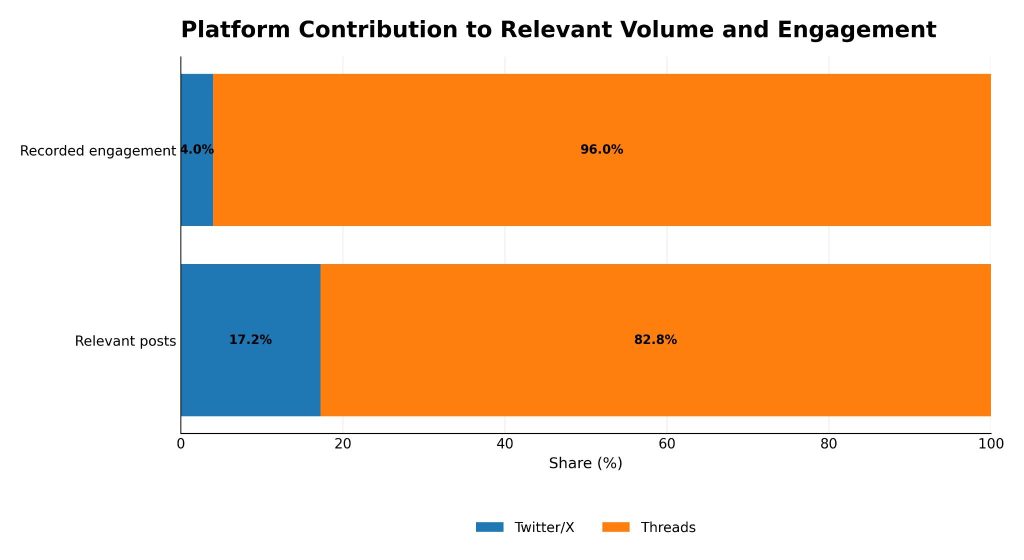
Figure 1 shows that Threads dominated both the volume and reach of the discussion, accounting for 173 of 209 relevant posts (82.8%) and 96.0% of recorded engagement; Twitter/X contributed 17.2% of posts and 4.0% of engagement.
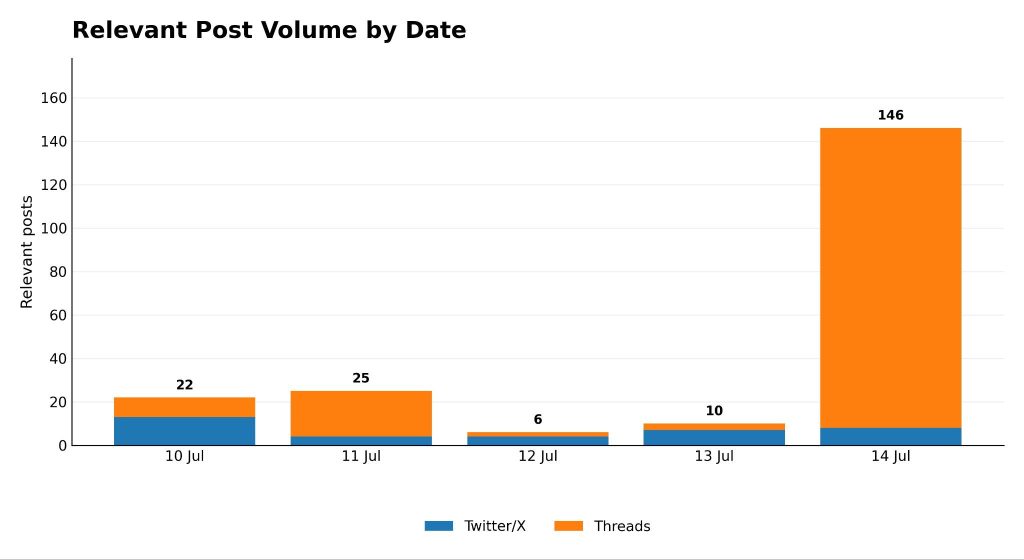
Figure 2 shows a sharp one-day surge on 14 July, when 146 relevant posts appeared, representing 69.9% of the entire analysed conversation. This suggests that the pattern was event-driven, particularly following Johor Menteri Besar @onnhafiz’s call for an investigation. The conversation continued to gain traction for several days after 14 July.
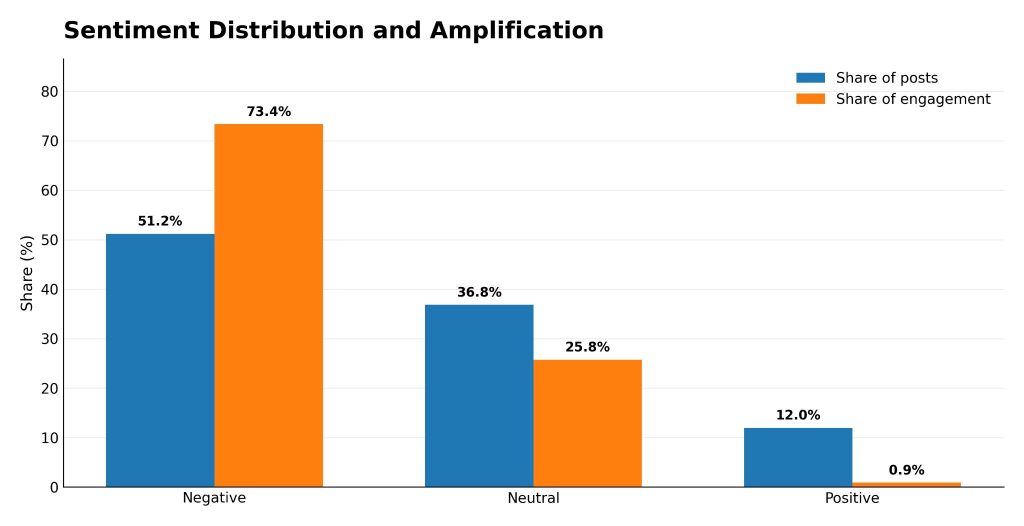
Figure 3 presents the sentiment analysis, showing that the discussion was predominantly adverse. Negative posts formed the largest category at 107 of 209 posts (51.2%), followed by 77 neutral posts (36.8%) and 25 positive posts (12.0%). More importantly, negative content generated 95,162 interactions, equivalent to 73.4% of all recorded engagement. Neutral posts received 25.8%, while positive posts received only 0.9%. This shows that the online conversation about Network School was shaped disproportionately by a relatively concentrated set of highly engaging negative posts.
A small group of accounts dominated the discussion, particularly on Threads. The ten most-engaged posts generated 67.6% of all engagement, with the Threads accounts @official_abbylyea and @m_firdaus_official alone accounting for 32.2%. Other key Threads amplifiers were @fatin_ezaty and @t_ruzaini, while @SyazanaMI played a notable amplification role on Twitter/X. Media accounts such as @intraday.my, @sinardailymy and @beritaalhijrah kept the issue in circulation through repeated coverage. The verified Threads account of Johor Menteri Besar @onnhafiz became a key official reference point after calling for an investigation. Overall, individual accounts produced 75.6% of relevant posts and 72.7% of engagement, showing that unverified personal accounts, especially on Threads, could influence pressure and calls for action. This analysis did not assess whether the leading accounts displayed signs of coordinated inauthentic behaviour; that question warrants further investigation.
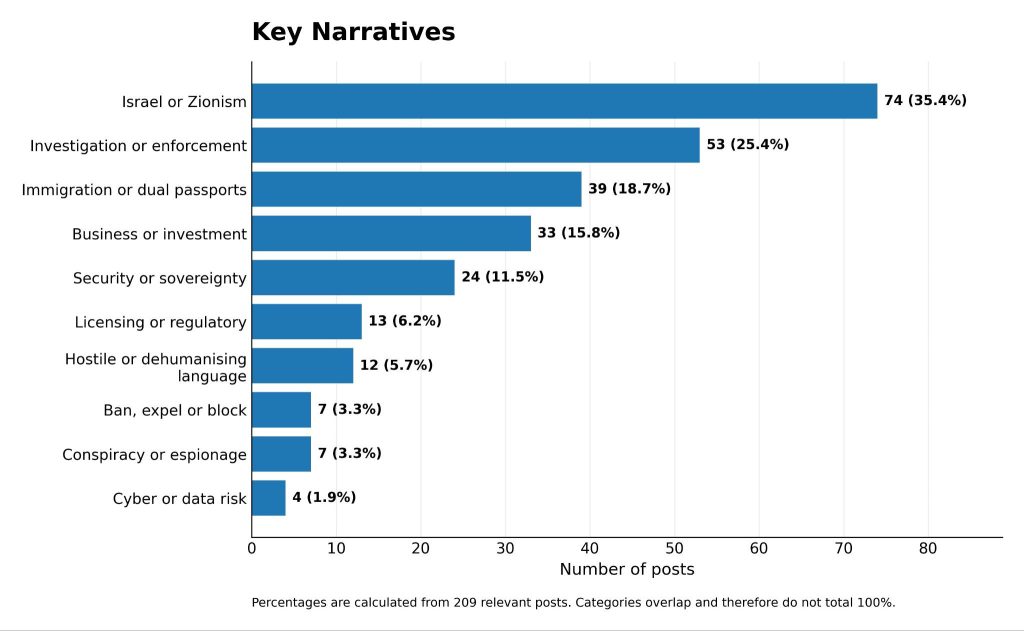
Based on Figure 4, allegations involving Israel or Zionism were the most common narrative, appearing in 74 posts (35.4%). They were followed by calls for investigation or enforcement in 53 posts (25.4%), immigration or dual-passport concerns in 39 (18.7%), business or investment issues in 33 (15.8%), and security or sovereignty concerns in 24 (11.5%). Additional narratives included licensing or regulatory concerns in 13 posts (6.2%), hostile or dehumanising language in 12 (5.7%), calls to ban, expel or block in 7 (3.3%), conspiracy or espionage claims in 7 (3.3%), and cyber or data risks in 4 (1.9%). These categories often overlapped: uncertainty about identity, entry status, ownership and licensing was used to support broader claims of hidden political intent, espionage or threats to sovereignty. Business discussion focused on Forest City’s reputation, investor confidence and legal compliance. Again, these figures describe online narratives, not proof that the allegations were accurate.
Implications on security and business
From a security perspective, the findings point to two risks: possible compliance gaps and the spread of unverified security claims.
Authorities should assess the issues raised against evidence and law. These include immigration status, second-country passports, ownership and funding, licensing, cybersecurity, and regulated financial or digital-asset services. Malaysia does not maintain diplomatic relations with Israel, and Israeli passport holders are not permitted to enter. Allegations that Israeli nationals participated using other passports therefore warrant identity and immigration checks, including lawful screening of any military affiliations given Israel’s military-service system and the involvement of the Israel Defence Forces in the occupation of Palestinian territories.
Claims about “startup societies” or alternative governance should be clarified where they suggest state-like functions, conflict with public-order requirements, or weaken Malaysia’s territorial and technological sovereignty, including control over jurisdiction, data and digital infrastructure.
Conspiracy, espionage and identity-based narratives are not established facts. The dataset does not verify claims of espionage, unauthorised entry, or military-linked activity as an organised sovereignty threat. Nationality, religion, cryptocurrency or technology work should not automatically be treated as evidence of subversion. Doing so could fuel harassment, deepen mistrust and divert agencies from demonstrable breaches.
For business, the main risk lies in the interaction between regulatory uncertainty and concentrated negative amplification. Fragmented oversight can create perceptions that foreign ventures receive special treatment, while enforcement based on viral claims can weaken confidence in predictable regulation. The founder’s decision to place further investment on hold followed scrutiny and regulatory attention, but does not demonstrate broader weakness in Malaysia’s investment environment. As a growing middle power in the region, Malaysia must remain competitive with neighbouring economies in attracting technology investment while protecting territorial and technological sovereignty through clear, consistent rules and due process.
Recommendations
First, conduct a coordinated federal–Johor compliance and security review. It should examine immigration status, travel documents, military affiliations, corporate ownership and funding, taxation, licensing, accommodation and education activities, digital-asset services, cybersecurity and personal-data handling. Enforcement should be tied to specific conduct and law.
Second, communicate verified findings promptly. The government should distinguish confirmed findings, matters under review and unsupported allegations, while clarifying entry restrictions and immigration requirements. This would reduce the information vacuum without prejudging investigations.
Third, establish clearer rules for hybrid organisations. A framework for residential innovation campuses, co-living accelerators and similar organisations could require a Malaysian legal entity, beneficial-ownership disclosure, a local compliance officer, participant records, appropriate visas, financial reporting, data-protection safeguards, disclosure of data-storage and cross-border access arrangements, and relevant approvals. Such organisations should remain subject to Malaysian law despite operating in the Special Economic Zone.
Fourth, strengthen narrative-risk monitoring. Government and business should track post volume, concentrated engagement, calls for exclusion, hostile language and the merging of immigration, geopolitical, military, espionage and sovereignty claims. These indicators should trigger faster factual communication and coordinated risk assessment.
The appropriate policy remains regulated openness: uphold Malaysia’s position on Palestine, enforce immigration and security requirements consistently, investigate credible risks and welcome legitimate innovation. This balance protects Malaysia’s territorial and technological sovereignty while preserving its standing as a stable, rules-based and competitive place to invest.